
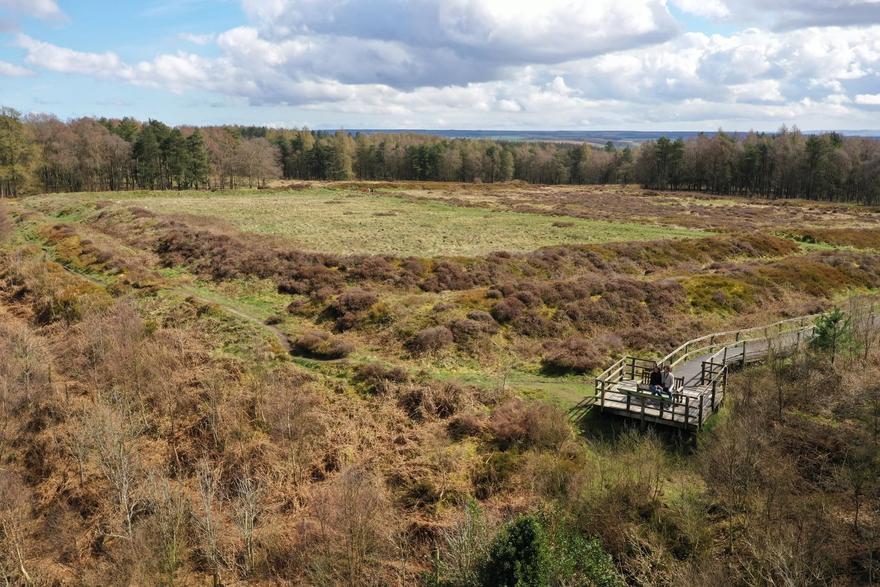
Where can you find curious playing card shapes in the North York Moors landscape? Today the outline of Cawthorn Camps near Pickering is defined by little more than a series of long lines of hillocks and ditches. Yet this belies the site's importance when, around 2000 years’ ago, the Romans created two forts and a training camp as part of its strategic defence to quell threats from the troublesome local tribes.
Cawthorn was one of the northernmost outposts of the Roman occupation following the successful invasion of southern England. It was only after the warlike tribe, the Brigantes, staged an anti-Roman rebellion that troops were sent north. After constructing a legionary fortress in York in AD71, the Roman forces radiated out from the city and into the surrounding countryside, building military roads and camps such as Cawthorn. The distance between these camps is a telltale sign of how far Roman troops marched in a day as it was only at the end of a day’s walking that they would have been ordered to build a fortification.
At Cawthorn the two forts had massive ramparts and large ditches with the temporary camp lying in between them. Today, as you look out across the site’s commanding position across to the earthworks and to Cropton Forest and the Tabular Hiills beyond, it’s hard to think of this being the front line action of tense encounters between the Romans and the Brigantes. However walk the easy one-mile Edge of Empire Trail created by the National Park and stand on the viewing point and you’ll be able to appreciate the Roman ingenuity and their defensive might.
Words by Amanda Brown, image NYMNPA